

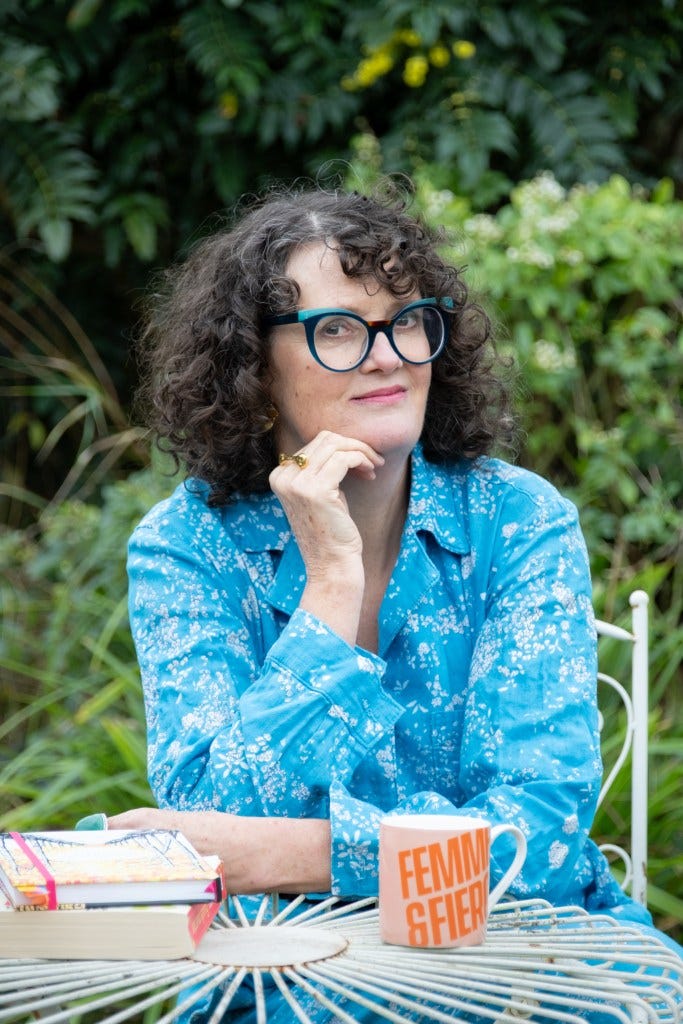
Menopause is so often spoken about in clinical terms, symptoms to manage, hormones to correct, productivity to preserve. But Kate Codrington, menopause facilitator, author, and speaker, has spent years offering women a radically different lens. One rooted in cycles, seasons, and rites of passage. Rather than asking women to push through or fix themselves, Kate invites a deeper question: What if this transition is asking something of us, not taking something away? In this conversation, we explore menopause as an initiation into embodied authority, grief as a necessary companion to renewal, and how cyclical awareness can soften fear and restore dignity during one of life’s most misunderstood transitions.
You’ve long spoken about menopause as a rite of passage rather than a medical problem. What changes when women view this transition as an initiation instead of something to ‘fix’?
Understanding that something new and scary is actually a rite of passage instead of something to fix changes everything. Resisting the narrative of being ‘deficient’ means we have to step out of the mainstream torrent of social media that drives panic and dysfunction. This can be hard to do alone, but the rewards are transformational. It returns your dignity, gives meaning, and purpose to the process. The mental and physical challenges become meaningful in themselves, inviting us to pay attention. Instead of pushing through the pain, it offers an opportunity to be curious about what is happening inside us, demonstrating that yes, we are worthy, we are enough.
It’s helpful to find communities where you can find an agreement to support this initiation, because although on one level it is a uniquely personal process, rites of passage need to be witnessed in community.
You work with the concept of life cycles and seasons. How does understanding cyclical living help women navigate the emotional and physical shifts of perimenopause and menopause more compassionately?
Understanding the seasons brings enormous reassurance to the process of perimenopause. Just knowing to expect to become more sensitive, and more porous, and understand that it’s normal at this time of life, is a game-changer. If we are lucky enough to have encountered cyclical awareness before perimenopause, we can understand more deeply how to care for ourselves in the menopause transition. Learning what supports and what triggers us in our menstrual Autumns (the luteal phase) and Winters (your period) translates directly into how you can care for yourself later in perimenopause. Perhaps the most growthful thing that cyclical awareness gives us is that we get to know more of our shadow each month in the luteal Autumn. So that when we come to the big Autumn of perimenopause, we have more capacity to hold ourselves in highly charged and difficult states of being, whether that is strong emotions like rage or grief, or brain fog and ‘not knowing’. Each cycle can be both a ‘practice run’ and a lesson in trust that Spring always comes.
Many women experience grief in midlife for their younger bodies, past identities, or unlived lives. How do you see menopause opening space for this grief to be acknowledged and integrated?
Grief is a natural part of this transition. It’s part of the editing and sorting process in the Life Autumn of perimenopause that’s also present in the menstrual Autumn. This is the time to assess what we have lost, how we have been betrayed, what we have not achieved, and
what we long for. It’s a time of reckoning, where we rediscover what our truth is as we move closer to our true Self. The Autumn moves us away from societal ideals of how we might succeed and how we might fit in with society, which are so compelling in the Spring and Summer. In the second half of the cycle, we move towards becoming more ourselves: more ‘soul-led’ rather than ‘success-led’.
I would recommend getting curious about these losses: what we imagined we could be and who we might be in the future. For example, we mourn the loss of our younger body, but what is it that we think a younger body would give us? Approval? Love? Acceptance? Better to work on these in ourselves than to look for them outside, as we age in an ageist world.
All that we have lost must be grieved, and this sifting and sorting are essential tasks to facilitate the renewal of a new cycle. After the cave time of menopause, we move into a second cycle: a Second Spring, Second Summer, Second Autumn, and Second Winter. Seasons where living our Calling becomes central to our focus, so the letting go and grieving have to be done: you don’t want to carry too much baggage into your 60s, 70s, and 80s!
You’ve written about reclaiming authority over our own bodies. What does embodied authority mean for women whose symptoms have been understood, minimised, or dismissed?
If you were brought up as a female, there is so much approval for caring for others that our authority gets lost. Most of us catastrophically underestimate how much we are holding: the emotional labour, the mental labour, managing our big and small T trauma, our sensitivities, and neurodivergence. This invisible work is exhausting! Part of reclaiming our authority is to notice that I am exhausted and I need more for myself; it’s time to drop those high expectations and let things get a little messy.
My experience has been that reclaiming authority starts with the intention to develop self-compassion. We start by meeting our own vulnerability with kindness, a little bit at a time, and as best as we can. If we can accept at least some of what is happening to us, it makes it easier to stand up for ourselves when we need to advocate for care and support. Embodied authority means taking your needs seriously and having a non-negotiable framework of care, so that the pillars of well-being: nourishment, sleep, movement, mind, and community are all in place.
It’s important to bring a curious mindset to our self-care, and notice what is working and what’s not, and also not to be too rigid with our care, so we can avoid hypervigilance. Instead, we can flow with what we need, because what you might need one day may be impossible the next, and that’s why self-compassion comes before care.
Midlife often prompts women to reassess their work, relationships, and contributions. From your perspective, what questions is menopause really asking us to answer?
The answer is really simple, but working through this process is not simple: Menopause is asking us to come into a relationship with the Self. It requires us to surrender our ego, and this is painful and horrible. It often requires us to acknowledge that, actually, we don’t really know who we are or what we want. It requires us to be vulnerable. It requires us to go against everything that we have learned will help us survive in our fertile years, and though this may look and feel like a catastrophe, all of this is a journey back to the Self so that we can live our second cycle postmenopause, closer to our calling
How do you help women separate what is truly hormonal from what is cultural, expectations, conditioning, and lifelong self-abandonment that menopause begins to surface?
I think it’s almost impossible to sort out what is hormonal from what is cultural conditioning, self-abandonment, or trauma. The attempt to do this often ends up in overthinking and a hypervigilance that amounts to picking scabs. You are more than your conditioning. More than your trauma! Much, much more! Make the pillars of your well-being unconditional. Then, once that’s in place, bring more pleasure, creativity, and delight into your life. This everyday magic will reduce your stress, support your endocrine system, your mental health, your self-esteem, and even affect your weight. It can really be as simple and as complex as putting yourself first.
If you could offer one reframe to women entering perimenopause, something that might soften fear and invite trust, what would you want them to know about this stage of life?
The reframe I would offer is that perimenopause is inviting you to be kind to yourself, to give yourself the love, affirmation, and validation you have been looking for externally for 40+ years. Now it is time to look within.
Go slow, say no, do you? This will bring you back to yourself.
What Kate reminds us, again and again, is that menopause is not a personal failure or a medical malfunction. It is a profound reorientation towards the Self. A time that asks for honesty, self-compassion, and the courage to let go of identities, expectations, and patterns of self-abandonment that no longer fit. When menopause is witnessed, held in community, and approached with curiosity rather than fear, it becomes less about surviving symptoms and more about reclaiming meaning, authority, and calling.
If this conversation has stirred something in you, Kate offers a generous free resource library including seasonal graphics, Yoga Nidra meditations, and supportive tools to accompany you through this transition: https://subscribepage.io/kates-resource-library.
You can also find and follow Kate’s ongoing reflections and teachings on Instagram: https://www.instagram.com/kate_codrington/.
This is not about becoming someone new. It’s about remembering who you are and allowing the next season of life to meet you there.
If this piece stayed with you, don’t rush past it. Let it settle.
You can take this further inside The Midlife Circle, where I share more personal reflections, deeper conversations, and gentle guidance to help you live this chapter with more clarity, intention, and ease.
If you’re feeling the pull to go deeper in a more personal way, you can also explore working with me. And if this resonated, tap the ♡, leave a comment, or share it with someone who might need this today.